
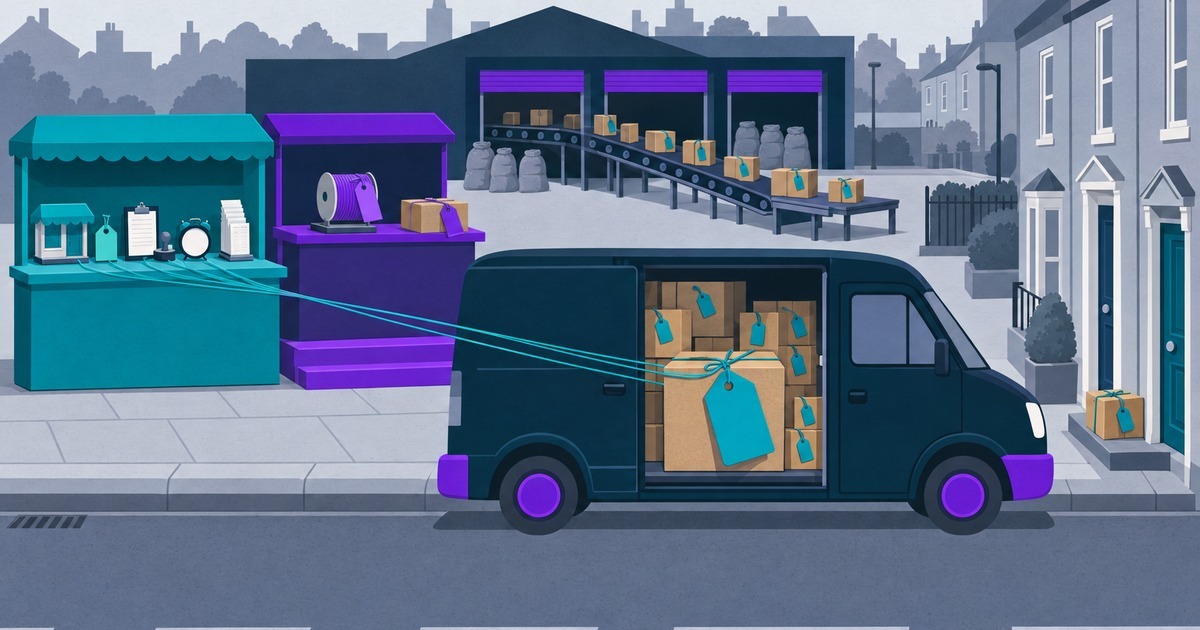
Most of the slow, expensive, physical work in inbound cross-border e-commerce is already done by the national post. It runs the gateway where the bags arrive and the round that reaches every address in the country. It also holds the trust a recipient gives the postal uniform at the door. I honestly don't think anyone else in most countries has all three. When a commercial director asks me how a post gets into commercial parcel quickly, that's where I start.
GN TEQ, where I work, is a member of the UPU's Consultative Committee, so I spend a lot of time with the sector's numbers and the people behind them. What I keep noticing is whose name is on the label. Much of the cross-border e-commerce a post delivers was sold by somebody else, who owns the merchant and sends the invoice. I believe that's actually where the opportunity sits, because those parcels are already in the van.
In short: A national post already runs the inbound gateway, the delivery round and the recipient's trust, yet much of the cross-border e-commerce it delivers was sold by someone else. The fastest route into commercial parcel is a commercial inbound service sold directly to merchants and platforms, as a second line of business beside the last-leg work the post already does. Saudi Post Logistics cut onboarding for that kind of service from over two months to two to three days, as published by the UPU in October 2024.
What does a national post already run on inbound cross-border e-commerce?
A national post already runs the inbound gateway, the delivery round to every address in the country and the recipient's trust in the postal brand at the door.
Each of those took decades to build, and none of them can really be bought in a hurry. The gateway is where bags come off the aircraft, get presented to customs and are sorted overnight. The round is the last mile in its plainest form, reaching addresses most networks would probably rather not serve. A recipient will open the door to a postal uniform without a second thought. They'll usually call the post first when something goes wrong.
That's why integrators, foreign posts and consolidators hand their parcels to the post for the last leg. By last leg I mean the delivery a post performs on a parcel another party sold. It's real revenue, and the partners who send it are good customers. I'd never suggest a post walks away from that work.
Whose label is on an inbound e-commerce parcel, and what sits behind it?
On much of the inbound e-commerce a post delivers, the label belongs to an integrator, a foreign post or a consolidator. Behind that label sit five things the post does not own: the merchant, the price, the customs declaration, the tracking promise and the invoice.
By integrator I mean an express or e-commerce logistics company that sells cross-border delivery to merchants and hands destination delivery to a local carrier. I think it helps to walk through them one at a time, because the post's position is a bit different on each.
The merchant is the seller, and the post usually knows the recipient far better than it knows who sold the item. The price was agreed between the merchant and the label owner. The post's rate for the last leg was set somewhere else, often long before the parcel existed. For items from another post, that rate comes from the UPU's remuneration system. For an integrator it's a contract, so the post sets neither. The customs declaration comes from the label owner's data. When it's wrong, the parcel still stops at the post's gateway. The post's customs team can then lose an afternoon to a declaration it never wrote. The tracking promise was made at the merchant's checkout, probably with a date the post never saw. The invoice goes from the label owner to the merchant, and the post bills the label owner for its part.
Put together, it seems the last leg is the part of the journey that pays least and gets blamed most. When a parcel is late, the recipient rarely knows who sold the delivery, so they ring the name on the van. The partners aren't villains here, to be honest, because they pay the post for real work.
It's a bit like a good restaurant that does most of its trade through a delivery app. The kitchen cooks every meal, and the customer judges the restaurant by the food. The app holds the customer's details, sets the price, takes the order and keeps the receipt. Most restaurants I know wouldn't leave the app, because it brings orders they'd never get alone. Plenty have opened their own ordering line beside it, though, and none of them rebuilt the kitchen first.
From the shipper's side, the same label shapes how a shipper chooses between the postal and the commercial channel.
How can a post see how much of its inbound volume someone else sold?
A post can measure, on its own gateway, the share of its inbound volume that someone else sold. Sort a normal week of inbound e-commerce items by whose label they wear. The share sold by others is the commercial parcel opportunity already in the van.
I haven't seen a reliable figure for that share anywhere, and I suspect it varies a lot by country. The UPU's numbers do show the national picture, though. Its State of the Postal Sector 2026 looks at the median designated operator, meaning the post each country designates under the UPU. That operator holds 74% of its domestic letter market, 39% of express items and only 27% of its parcel market, on the UPU's figures.
In the report's words, a median of 27% means the typical operator "has lost (or never held) roughly three quarters of its national parcel market". I think the bracket is the most honest part, because in many markets the post never had that parcel customer to lose. Weighted by volume the share rises to 57%, which the report puts down to a few large markets.
The gap is widest where revenue is weakest, the UPU finds, at a median parcel share of 61% in industrialised countries and 16% in Africa and in the Arab region. The same report puts the average EBIT margin across 53 operators at minus 0.8% in 2024, which leaves little room to wait.
None of that tells a post its own inbound share, of course. For each label owner in that week's sort, note who holds each of the five things. I'd imagine the surprise is usually the number of label owners. Very few of their merchants will ever have spoken to the post.
What are a post's options for moving into commercial parcel?
A post has five routes into commercial parcel. They differ most in who keeps the merchant and how long each takes to earn. Each one is a reasonable choice for somebody.
- Staying the last leg is low risk and needs no new system. The rates are set by others, though, and the complaints still arrive.
- Partnering with an integrator or a foreign post brings coverage and volume quickly, while the partner keeps the merchant, the price and the data.
- An in-house build gives full control. It also joins the IT queue behind the universal service, and nobody can honestly write down a date for it.
- A platform tender is thorough, and the slowest of the five to earn.
- Opening a commercial inbound service to merchants and platforms directly is one step upstream on parcels already in the van. The post owns the relationship and the invoice, and has to take each shipper's data in the shipper's format.
I'd see the fifth as a second line of business beside the last-leg work, not a replacement for it. A post can keep delivering for its partners and still sell to merchants who'd rather ship with it directly. The fifth probably costs the least in time, though, because the gateway and the round it depends on are already running.
Its domestic cousin is what the branch estate can do once it holds a merchant's stock, but here I'm talking about inbound parcels only.
Which route into commercial parcel is fastest?
The fastest route into commercial parcel is a commercial inbound service sold directly to merchants and platforms, on the kind of volume the post already delivers. The parcels are already in the van, so the new work is per shipper and takes days, where a tender or a build takes years.
From what I see, a platform tender in this sector usually runs about two years. Anything tendered now probably won't earn before 2028. An in-house build often looks quicker on paper, then waits behind the universal service, which has to come first. I wrote recently about the gap between deciding and having a live capability at the border. This is the same gap, for one shipper.
Merchants move much faster than any of those timelines. After the US ended de minimis on 29 August 2025, the UPU's State of the Postal Sector 2026 shows origins sending goods there falling from 176 to 133 in a month. Shippers re-route in weeks, and the label owner decides where their parcels go.
The step upstream is the one route that moves at that speed, because the new work is the five things, one shipper at a time.
What does a commercial inbound service have to get right?
A commercial inbound service works when it takes each shipper's label and customs data in the shipper's own format and onboards a merchant in days. It also has to keep one tracking promise across every leg, price per lane and add volume without downtime at the gateway.
If I were a commercial head, I'd put these on one page and ask who owns each line.
- Accept a shipper's label and customs data in the shipper's own format, because a merchant won't rebuild its checkout for one destination.
- Onboard a merchant in days, which is really a question of how fast an operator adds the next partner.
- One tracking promise across every leg, in the post's name.
- A price per lane that the post decides for itself. Nobody else should be setting it.
- Take volume from hundreds to hundreds of thousands a week without downtime at the gateway.
- Send the invoice from the post, in the post's name.
Most of this can be tested this quarter without a tender. Pick one shipper whose parcels are already in the van. Ask what it would take for them to book with the post directly. Write down the onboarding time you'd promise and who owns it. Then decide the price per lane you'd set, ideally before the first conversation.
Has a national post already made this move?
Yes, Saudi Post Logistics went from delivering the last leg of parcels others had sold to running cross-border commercial parcel end to end. SPL now owns the merchant, the price, the customs declaration, the tracking promise and the invoice.
That change is the story more than any single figure, because it changed what kind of operator SPL is. In October 2024 the UPU reported that the work "reduces onboarding time from over two months to just two to three days". Its April 2025 article repeated the figure. The October 2024 article says volumes grew "from minimal amounts to hundreds of thousands per week, all without downtime at inbound gateways". That October 2024 article also reports a "98% delivery success rate over four months". SPL's own reported results from January 2025 put international commercial shipments at zero before and more than 3 million after. The same results show processing per package falling from 3 minutes to 2 seconds.
What changed day to day is quite plain in the UPU's April 2025 account. Customs data reaches the Saudi authorities before the parcel does, so parcels can clear before they land. Invoices go out on set billing cycles, and recipients can follow a parcel from departure to delivery.
None of that needed a new delivery network, because SPL already had one. If you run commercial at a post, I'd suggest starting with your own gateway next week, perhaps with a simple count of whose labels came through it.
Questions we get asked
Who owns the customer on inbound cross-border e-commerce parcels?
The party whose label the parcel wears, usually an integrator, a foreign post or a consolidator, owns the merchant, the price, the customs declaration, the tracking promise and the invoice, while the post delivering the last leg owns the moment at the door. A post can see the split for itself by sorting a normal week of inbound items by the party whose label they wear.
How can a postal operator get into commercial parcel quickly?
By selling a commercial inbound service directly to merchants and platforms on the kind of volume it already delivers, which needs per-shipper onboarding rather than a new network, a tender or an in-house build. The physical network and the recipient's trust are already in place, so the new work is the step upstream.
How long does it take a national post to onboard an international shipper?
At Saudi Post Logistics it took two to three days per merchant, down from over two months, as published by the UPU in October 2024 and April 2025.
Does selling directly to shippers mean competing with the integrators a post delivers for?
It does not have to: a commercial inbound service runs as a second line of business beside last-leg delivery for integrators and foreign posts, serving merchants and platforms that want to ship to the post directly. The partners keep their own merchants, and the post keeps delivering for them.
Related reading
- The State of the Postal Sector 2026: Orchestrating a postal future (Universal Postal Union)
- Automation at the core: GN TEQ and Saudi Post enhance e-commerce efficiency in Saudi Arabia (Universal Postal Union, April 2025)
- The UPU says the post decides too slowly. The last year shows a second clock.
- Everyone in London said specialise. Nobody said who connects the partners.
- Postal, commercial or your own partner
- Why go cross border in 2026, Part 5